Buy watchnudefree.eu ?
We are moving the project
watchnudefree.eu .
Are you interested in purchasing the domain
watchnudefree.eu ?
domain@kv-gmbh.de · 0541-91531010
Buy watchnudefree.eu ?
How can one filter wavelengths?
One can filter wavelengths by using materials that selectively absorb or transmit certain wavelengths of light. For example, colored filters can be used to absorb specific wavelengths of light while allowing others to pass through. Additionally, interference filters can be used to selectively transmit certain wavelengths by exploiting the wave nature of light. These filters are made by depositing thin layers of materials with specific optical properties onto a substrate. By carefully designing the thickness and composition of these layers, interference filters can be engineered to transmit only the desired wavelengths of light. **
How can wavelengths be filtered?
Wavelengths can be filtered using various optical filters such as bandpass filters, longpass filters, and shortpass filters. These filters work by selectively transmitting or blocking certain wavelengths of light while allowing others to pass through. Bandpass filters only allow a specific range of wavelengths to pass through, while longpass filters transmit longer wavelengths and shortpass filters transmit shorter wavelengths. By using these filters, specific wavelengths of light can be isolated or removed from a light source. **


Similar search terms for Wavelengths
Top-Angebote
Products related to Wavelengths:
-
Ronald Redding Streaming Cheetah Linen WallpaperMarble veining and animal skin combine to compose a stream of color and print in pattern Streaming Cheetah. This Streaming Cheetah Wallpaper measures approximately 27 inches wide by 27 feet long, covering About 60.8 square feet per roll.136,00 $*Shipping: 0,00 $Secure redirect to the provider
-
Tyler Akidau Streaming Systems - Non Fiction - PaperbackTitle:. Streaming Systems Condition: BRAND NEW. Format: Paperback Overview:. Streaming data is a big deal in big data today, and Streaming Systems translates that passion into a practical, hands‑on guide. Written for data engineers, data scientists, and developers, this book presents streaming as a core architectural capability rather than a niche tool. It offers a platform‑agnostic view that focuses on concepts you can apply across diverse systems, rather than tying you to a single vendor or framework. Expanded from Tyler Akidau's popular blog posts “Streaming 101” and “Streaming 102,” the guide advances readers from a friendly introduction to a nuanced mastery of the what, where, when, and how of processing real‑time data streams. You’ll dive into crucial topics like watermarks, event time, and windowing, and you’ll explore exactly‑once processing with guidance on building reliable pipelines at scale. The book guides you through end‑to‑end streaming pipelines—from data arrival and windowed aggregation to handling late data and ensuring consistency as streams grow. It’s a must for teams delivering real‑time analytics, dashboards, and event‑driven architectures that demand both speed and accuracy. What Makes This Book Stand Out:. What sets Streaming Systems apart is its emphasis on engineering practicality without sacrificing conceptual clarity. The authors weave theory into real‑world patterns, helping you design robust streaming architectures that withstand data deluges and evolving tech ecosystems. You’ll gain a thorough understanding of watermarks and exactly‑once semantics, including the trade‑offs involved in different approaches. The platform‑agnostic lens means you can adapt the techniques to whatever stack you use, from on‑prem to cloud‑native environments. Clear, problem‑driven explanations are complemented by actionable guidance on building reliable streaming pipelines, diagnosing bottlenecks, and applying best practices to production workloads. Whether you’re prototyping a streaming solution or orchestrating a large‑scale rollout, this book provides a concrete, confidence‑building framework you can apply immediately. Who This Book Is Perfect For:. If you design, build, or operate systems that must process data in real time, this book is for you. It’s ideal for data engineers and software developers tasked with building streaming pipelines, as well as data scientists who need to understand the data’s temporal behavior to derive accurate insights. Early‑career readers will find the accessible entry points, while experienced practitioners will appreciate the deeper, motif‑driven analysis of stream processing concepts. Teams migrating to streaming architectures or striving to improve reliability, latency, and throughput will find the practical patterns and reasoning invaluable. It’s also a strong reference for students and educators focused on modern data engineering and real‑time analytics. Key Highlights:. Practical, engineering‑led...39,49 £*Shipping: 0,00 £Secure redirect to the provider
-
Rosso 'Naked' Weingut HeinrichThe Rosso “Naked” by Weingut Heinrich comes from a winery located in the area considered one of the hottest in Austria, precisely in Burgenland. The doctrine behind the work of this winery is the necessity to listen to nature, respecting it in all its phases and facets, in order to obtain wines in symbiosis with it and of rare quality. The fundamental idea is that human intervention in the vineyard should be minimized, aided only by natural substances, completely banning synthetic chemicals, pesticides, and herbicides; all of this is further supported by the choice of organic farming that helps create a healthy and lush habitat. The soils where the grapes for the Rosso “Naked” by Weingut Heinrich grow have a particular composition, as the cold limestone present can absorb the heat from solar radiation, ensuring excellent ripening of the grapes, also encouraged by the south-facing exposure of the vineyards. The climate is mainly continental with hot summers and harsh winters subject to frost. The grape harvest is done manually and the alcoholic and malolactic fermentations take place spontaneously thanks to the action of indigenous yeasts. Before being bottled, it ages for 12 months in wooden barrels. The Rosso “Naked” by Weingut Heinrich presents itself with an intense ruby red color with bright reflections. The bouquet of aromas is composed of notes of red fruits, delicate and pleasant spices; on the palate, it is easy-drinking, agile, and fruity for a generally harmonious and inviting structure. It pairs perfectly with dishes based on cuts of red meat cooked on the grill and stewed, but also with savory pies and vegetarian dishes. An excellent wine to share at the family festive table, sipping a product with multiple potentials and genuine, authentic flavors.17,00 £*Shipping: 48,00 £Secure redirect to the provider




-
Why do colors have different wavelengths?
Colors have different wavelengths because they are a result of different frequencies of light. The wavelength of light determines its color, with shorter wavelengths corresponding to colors like blue and violet, and longer wavelengths corresponding to colors like red and orange. When light interacts with an object, certain wavelengths are absorbed and others are reflected, which is what we perceive as color. Therefore, the different wavelengths of light are responsible for the variety of colors we see in the world around us. **
-
Why are the rings of an electron diffraction tube larger at higher wavelengths than at lower wavelengths?
The rings of an electron diffraction tube are larger at higher wavelengths than at lower wavelengths because the wavelength of the electrons is inversely proportional to their momentum. This means that as the wavelength increases, the momentum of the electrons decreases. With lower momentum, the electrons are less able to penetrate the atomic structure of the material being studied, resulting in larger diffraction rings. Conversely, at lower wavelengths, the higher momentum of the electrons allows them to penetrate the atomic structure more effectively, resulting in smaller diffraction rings. **
-
What is the reflection of adjacent wavelengths?
The reflection of adjacent wavelengths refers to the phenomenon where light waves of different wavelengths are reflected off a surface. When light waves with adjacent wavelengths, such as red and orange, hit a surface, they may be reflected at different angles or with different intensities. This can result in the separation of colors, as seen in a rainbow or in the iridescence of certain materials. The reflection of adjacent wavelengths is a key factor in the perception of color and the behavior of light. **
-
How do you calculate wavelengths in water?
To calculate the wavelength of a wave in water, you can use the formula: wavelength = speed of wave / frequency of wave. The speed of the wave in water can be calculated using the formula: speed = frequency * wavelength. The frequency of the wave can be determined by the source of the wave, and the wavelength can be measured by observing the distance between two consecutive wave crests or troughs. By using these formulas, you can calculate the wavelength of a wave in water. **

How can I play Life is Strange: Wavelengths?
To play Life is Strange: Wavelengths, you will need to have the base game Life is Strange: True Colors installed on your gaming platform. Wavelengths is a DLC (downloadable content) episode that focuses on the character Steph Gingrich. Once you have the base game, you can purchase and download the Wavelengths DLC from the respective digital store for your platform, such as Steam, PlayStation Store, or Xbox Store. After downloading the DLC, you can access and play Wavelengths from within the main menu of Life is Strange: True Colors. **
What are the wavelengths of the Lyman series?
The Lyman series consists of ultraviolet spectral lines in the hydrogen atom. The wavelengths of the Lyman series range from approximately 91 nm to 122 nm. These wavelengths correspond to transitions of electrons in hydrogen atoms from higher energy levels to the ground state. The Lyman series is named after its discoverer, Theodore Lyman. **
Top-Angebote
Products related to Wavelengths:
-
Unicskin Unicled 5.0 Centurion Korean Mask with 8 Wavelengths and AI 1 un.A facial mask for dark spots and uneven skin tone. Painless, needle-free, and scientifically proven to transform your skin in just 20 minutes. Delivers visible results in just one session. Treats the full face: forehead, nose, cheeks, lip area and nasolabial folds. Targets multiple skin concerns: wrinkles, acne, dark spots and loss of firmness.381,95 £*Shipping: 0,00 £Secure redirect to the provider
-
Bloom Books Priest Trilogy 3 Books Collection Set by Sierra Simone - Priest, Sinner, Saint - Adult Erotic Romance Paperback Set -The Priest Trilogy brings together Sierra Simone's three TikTok-famous, USA Today bestselling novels—Priest, Sinner, and Saint—in one brand-new paperback collection published by Bloom Books. Following the three Bell brothers as each confronts faith, temptation, and forbidden desire, this trilogy has become a modern phenomenon in steamy, emotionally charged romance. Ideal for adult readers who love morally complex characters and stories that ask whether devotion and desire can coexist, this set is a must-own for fans of bold, provocative contemporary fiction. About the Books In Priest, Father Tyler Bell has spent three years quietly honoring his vows after a family tragedy pushed him towards the priesthood—until a stranger's confession through the screen of his confessional booth threatens to unravel everything he believes. Sinner turns to his brother Sean...11,49 £*Shipping: 2,99 £Secure redirect to the provider
-
Ronald Redding Streaming Cheetah Linen WallpaperMarble veining and animal skin combine to compose a stream of color and print in pattern Streaming Cheetah. This Streaming Cheetah Wallpaper measures approximately 27 inches wide by 27 feet long, covering About 60.8 square feet per roll.136,00 $*Shipping: 0,00 $Secure redirect to the provider
-
How can one filter wavelengths?
One can filter wavelengths by using materials that selectively absorb or transmit certain wavelengths of light. For example, colored filters can be used to absorb specific wavelengths of light while allowing others to pass through. Additionally, interference filters can be used to selectively transmit certain wavelengths by exploiting the wave nature of light. These filters are made by depositing thin layers of materials with specific optical properties onto a substrate. By carefully designing the thickness and composition of these layers, interference filters can be engineered to transmit only the desired wavelengths of light. **
-
How can wavelengths be filtered?
Wavelengths can be filtered using various optical filters such as bandpass filters, longpass filters, and shortpass filters. These filters work by selectively transmitting or blocking certain wavelengths of light while allowing others to pass through. Bandpass filters only allow a specific range of wavelengths to pass through, while longpass filters transmit longer wavelengths and shortpass filters transmit shorter wavelengths. By using these filters, specific wavelengths of light can be isolated or removed from a light source. **
-
Why do colors have different wavelengths?
Colors have different wavelengths because they are a result of different frequencies of light. The wavelength of light determines its color, with shorter wavelengths corresponding to colors like blue and violet, and longer wavelengths corresponding to colors like red and orange. When light interacts with an object, certain wavelengths are absorbed and others are reflected, which is what we perceive as color. Therefore, the different wavelengths of light are responsible for the variety of colors we see in the world around us. **
-
Why are the rings of an electron diffraction tube larger at higher wavelengths than at lower wavelengths?
The rings of an electron diffraction tube are larger at higher wavelengths than at lower wavelengths because the wavelength of the electrons is inversely proportional to their momentum. This means that as the wavelength increases, the momentum of the electrons decreases. With lower momentum, the electrons are less able to penetrate the atomic structure of the material being studied, resulting in larger diffraction rings. Conversely, at lower wavelengths, the higher momentum of the electrons allows them to penetrate the atomic structure more effectively, resulting in smaller diffraction rings. **
Similar search terms for Wavelengths
-
Tyler Akidau Streaming Systems - Non Fiction - PaperbackTitle:. Streaming Systems Condition: BRAND NEW. Format: Paperback Overview:. Streaming data is a big deal in big data today, and Streaming Systems translates that passion into a practical, hands‑on guide. Written for data engineers, data scientists, and developers, this book presents streaming as a core architectural capability rather than a niche tool. It offers a platform‑agnostic view that focuses on concepts you can apply across diverse systems, rather than tying you to a single vendor or framework. Expanded from Tyler Akidau's popular blog posts “Streaming 101” and “Streaming 102,” the guide advances readers from a friendly introduction to a nuanced mastery of the what, where, when, and how of processing real‑time data streams. You’ll dive into crucial topics like watermarks, event time, and windowing, and you’ll explore exactly‑once processing with guidance on building reliable pipelines at scale. The book guides you through end‑to‑end streaming pipelines—from data arrival and windowed aggregation to handling late data and ensuring consistency as streams grow. It’s a must for teams delivering real‑time analytics, dashboards, and event‑driven architectures that demand both speed and accuracy. What Makes This Book Stand Out:. What sets Streaming Systems apart is its emphasis on engineering practicality without sacrificing conceptual clarity. The authors weave theory into real‑world patterns, helping you design robust streaming architectures that withstand data deluges and evolving tech ecosystems. You’ll gain a thorough understanding of watermarks and exactly‑once semantics, including the trade‑offs involved in different approaches. The platform‑agnostic lens means you can adapt the techniques to whatever stack you use, from on‑prem to cloud‑native environments. Clear, problem‑driven explanations are complemented by actionable guidance on building reliable streaming pipelines, diagnosing bottlenecks, and applying best practices to production workloads. Whether you’re prototyping a streaming solution or orchestrating a large‑scale rollout, this book provides a concrete, confidence‑building framework you can apply immediately. Who This Book Is Perfect For:. If you design, build, or operate systems that must process data in real time, this book is for you. It’s ideal for data engineers and software developers tasked with building streaming pipelines, as well as data scientists who need to understand the data’s temporal behavior to derive accurate insights. Early‑career readers will find the accessible entry points, while experienced practitioners will appreciate the deeper, motif‑driven analysis of stream processing concepts. Teams migrating to streaming architectures or striving to improve reliability, latency, and throughput will find the practical patterns and reasoning invaluable. It’s also a strong reference for students and educators focused on modern data engineering and real‑time analytics. Key Highlights:. Practical, engineering‑led...39,49 £*Shipping: 0,00 £Secure redirect to the provider
-
Rosso 'Naked' Weingut HeinrichThe Rosso “Naked” by Weingut Heinrich comes from a winery located in the area considered one of the hottest in Austria, precisely in Burgenland. The doctrine behind the work of this winery is the necessity to listen to nature, respecting it in all its phases and facets, in order to obtain wines in symbiosis with it and of rare quality. The fundamental idea is that human intervention in the vineyard should be minimized, aided only by natural substances, completely banning synthetic chemicals, pesticides, and herbicides; all of this is further supported by the choice of organic farming that helps create a healthy and lush habitat. The soils where the grapes for the Rosso “Naked” by Weingut Heinrich grow have a particular composition, as the cold limestone present can absorb the heat from solar radiation, ensuring excellent ripening of the grapes, also encouraged by the south-facing exposure of the vineyards. The climate is mainly continental with hot summers and harsh winters subject to frost. The grape harvest is done manually and the alcoholic and malolactic fermentations take place spontaneously thanks to the action of indigenous yeasts. Before being bottled, it ages for 12 months in wooden barrels. The Rosso “Naked” by Weingut Heinrich presents itself with an intense ruby red color with bright reflections. The bouquet of aromas is composed of notes of red fruits, delicate and pleasant spices; on the palate, it is easy-drinking, agile, and fruity for a generally harmonious and inviting structure. It pairs perfectly with dishes based on cuts of red meat cooked on the grill and stewed, but also with savory pies and vegetarian dishes. An excellent wine to share at the family festive table, sipping a product with multiple potentials and genuine, authentic flavors.17,00 £*Shipping: 48,00 £Secure redirect to the provider
-
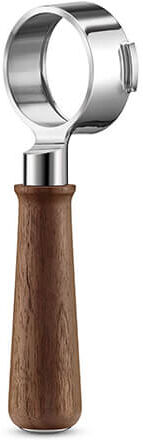
Sage Naked 54mm PortafilterIntroducing Sage the Naked Portafilter, a precision tool designed to help you fine-tune your espresso extraction with clarity and control. Crafted from durable stainless steel and finished with a beautifully balanced walnut handle, this portafilter adds an elegant touch to any Sage espresso setup while offering professional-level functionality. By exposing the bottom of the portafilter, the Naked design allows you to visually diagnose and troubleshoot your espresso shots in real time. Watch the flow, spot channelling, and adjust your grind, dose, or tamping technique to achieve the perfect pour. This level of visibility is essential for anyone looking to refine their espresso-making skills and consistently produce café-quality results. The ergonomic walnut handle is thoughtfully designed with a thumb stop for a secure and comfortable grip, ensuring stability and ease of use during every shot. Compatible with 54mm Sage portafilters, this tool integrates seamlessly into your existing setup, making it an ideal upgrade for home baristas and professionals alike. Complete with a Sage 2 year warranty. Dimensions: 22.3(H) x 5.7(W) x 7.5(D)cm.79,95 £*Shipping: 0,00 £Secure redirect to the provider
-
Sage Naked 58mm PortafilterIntroducing Sage the Naked Portafilter, a precision tool designed to help you fine-tune your espresso extraction with clarity and control. Crafted from durable stainless steel and finished with a beautifully balanced walnut handle, this portafilter adds an elegant touch to any Sage espresso setup while offering professional-level functionality. By exposing the bottom of the portafilter, the Naked design allows you to visually diagnose and troubleshoot your espresso shots in real time. Watch the flow, spot channelling, and adjust your grind, dose, or tamping technique to achieve the perfect pour. This level of visibility is essential for anyone looking to refine their espresso-making skills and consistently produce café-quality results. The ergonomic walnut handle is thoughtfully designed with a thumb stop for a secure and comfortable grip, ensuring stability and ease of use during every shot. Compatible with 58mm Sage portafilters, this tool integrates seamlessly into your existing setup, making it an ideal upgrade for home baristas and professionals alike. Complete with a Sage 2 year warranty. Dimensions: 22.4(H) x 6.1(W) x 7.9(D)cm.89,95 £*Shipping: 0,00 £Secure redirect to the provider
-
What is the reflection of adjacent wavelengths?
The reflection of adjacent wavelengths refers to the phenomenon where light waves of different wavelengths are reflected off a surface. When light waves with adjacent wavelengths, such as red and orange, hit a surface, they may be reflected at different angles or with different intensities. This can result in the separation of colors, as seen in a rainbow or in the iridescence of certain materials. The reflection of adjacent wavelengths is a key factor in the perception of color and the behavior of light. **
-
How do you calculate wavelengths in water?
To calculate the wavelength of a wave in water, you can use the formula: wavelength = speed of wave / frequency of wave. The speed of the wave in water can be calculated using the formula: speed = frequency * wavelength. The frequency of the wave can be determined by the source of the wave, and the wavelength can be measured by observing the distance between two consecutive wave crests or troughs. By using these formulas, you can calculate the wavelength of a wave in water. **
-
How can I play Life is Strange: Wavelengths?
To play Life is Strange: Wavelengths, you will need to have the base game Life is Strange: True Colors installed on your gaming platform. Wavelengths is a DLC (downloadable content) episode that focuses on the character Steph Gingrich. Once you have the base game, you can purchase and download the Wavelengths DLC from the respective digital store for your platform, such as Steam, PlayStation Store, or Xbox Store. After downloading the DLC, you can access and play Wavelengths from within the main menu of Life is Strange: True Colors. **
-
What are the wavelengths of the Lyman series?
The Lyman series consists of ultraviolet spectral lines in the hydrogen atom. The wavelengths of the Lyman series range from approximately 91 nm to 122 nm. These wavelengths correspond to transitions of electrons in hydrogen atoms from higher energy levels to the ground state. The Lyman series is named after its discoverer, Theodore Lyman. **
* All prices are inclusive of VAT and, if applicable, plus shipping costs. The offer information is based on the details provided by the respective shop and is updated through automated processes. Real-time updates do not occur, so deviations can occur in individual cases. ** Note: Parts of this content were created by AI.